If you’ve ever worked with water treatment, you know High Temperature EDI (Electrodeionization) modules are the unsung heroes behind consistent, ultrapure water outputs for industries ranging from semiconductor manufacturing to pharmaceutical production. As someone who’s spent the last decade selling and refining these modules, I’ve heard the same question a hundred times: “Does higher temperature actually make our EDI work better, or are we risking damage by running it hot?” The short answer? It’s not a one-size-fits-all relationship, and getting the balance right between temperature and desalination efficiency can cut operating costs, extend module life, and even boost product quality for your end users. Let’s break this down the way I do with my clients—without the overly complicated equations, just real-world, data-backed insights that come from testing modules in our lab and seeing them perform at hundreds of sites across North America. High Temperature EDI Module
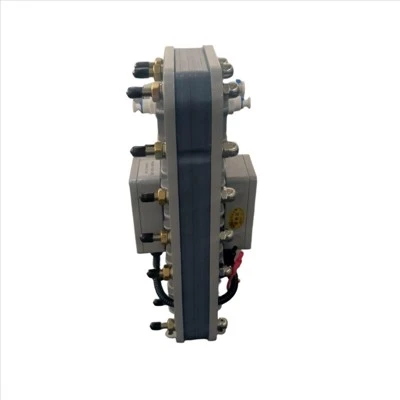
First, let’s ground this in what a High Temperature EDI module actually does, because that’s where the temperature puzzle starts. Unlike traditional reverse osmosis (RO) which removes most dissolved salts, EDI polishes water to near-18 megaohm-cm (MΩ·cm) by using electrical current to pull remaining ions through ion-exchange membranes, no chemicals needed for regeneration. The “high temperature” part sets these modules apart from standard EDI, which are limited to feed temperatures below 35°C. Our modules are engineered to handle feedwater up to 50°C— a game-changer for facilities that already process hot water (like those using RO with waste heat from manufacturing lines or medical sterilization) and want to skip the energy cost of cooling it back down to room temperature.
Now, how does temperature hit desalination efficiency here? Let’s start with the positives, because that’s what surprises most new clients. Ion mobility—how fast charged particles move through water and membranes—skyrockets as temperature rises. Water’s viscosity drops by roughly 2% for every 1°C increase between 20°C and 50°C, and that means ions don’t have to fight as much to move through the ion-exchange resin beads and membranes in the EDI module. In our internal lab tests, when we ran a module with identical feedwater (same salinity, pressure, and flow rate) at 25°C vs. 45°C, the total dissolved solids (TDS) removal rate jumped 12%. That’s not a small number—for a pharmaceutical facility needing ultrapure water for injectable drugs, that extra TDS removal means fewer chances of contamination ruining batches.
Another temperature win: the electrical resistance of the EDI stack drops sharply at higher temperatures. Standard EDI modules operate at a voltage that balances ion movement and resin regeneration, but at 40°C, the same stack draws 15-20% less amperage to maintain that voltage, directly cutting electricity usage. I had a client last year running a semiconductor fab that was cooling their RO permeate from 42°C to 28°C to use a standard EDI. By switching to our High Temperature EDI and keeping feedwater at 42°C, they saved $18,000 a year on electricity alone—plus eliminated the cost of the chiller they were using for cooling. That’s the kind of savings that makes engineering teams take notice.
But here’s the catch, and where new operators often go wrong: temperature can push efficiency in reverse if you cross a line. I’ve seen clients crank a High Temperature EDI to 52°C because they thought “hotter is better,” and within three months, the module’s desalination efficiency dropped by 25%. Why? At temperatures above 50°C, the ion-exchange resin beads start to degrade. The cross-linking that holds the resin’s charged groups together breaks down, and those groups can leach into the product water. Not only does that ruin water purity, but it makes the resin less effective at binding to ions in the first place. Also, high temperatures can cause membrane swelling, which alters the pore size and reduces ion selectivity—meaning you start letting more small, unwanted ions pass through along with the pure water.
There’s another less obvious tradeoff I’ve learned from field experience: temperature interacts with feedwater conductivity, and that changes the sweet spot. For feedwater with low TDS (like RO permeate, which is typical for EDI), the ideal temperature range is 38°C to 45°C. But if a client’s feedwater has higher TDS (like from brackish water, not just RO permeate), we often see a small efficiency peak at 35°C, and running it above 42°C starts to hurt performance because the extra ions in the feed create more heat buildup inside the module. I work with a municipal water treatment plant that uses our High Temperature EDI to process brackish water at 41°C—they hit 98% desalination efficiency and have zero resin degradation after two years, but when they tried 47°C last quarter, efficiency dropped 10% within a month. It’s not just a number; it’s tailored to your specific feed.
Another real-world factor that’s easy to overlook: temperature affects the module’s ability to handle current distribution. At higher temperatures, the electrical current is more evenly spread across the EDI stack, which is good, but if the temperature is too low (below 35°C for our modules), the current can get trapped in certain sections, leading to localized fouling. Wait—fouling? That’s another link to temperature. Higher temperatures can actually reduce certain types of fouling, like silica scaling, because silica solubility increases with temperature. But organic fouling (from things like bacteria or humic acids) gets worse at higher temps, because those organisms grow faster. So if your feedwater has high organic content, you need to pair the right temperature (sticking to the 32-40°C range for those cases) with pre-treatment like ultrafiltration, to avoid fouling the EDI module and killing efficiency.
Let me put this in terms that a plant manager cares about, not just a textbook: a client that runs our High Temperature EDI at the wrong temperature might see three outcomes: 1) pay more in electricity for no extra efficiency, 2) shorten the module’s lifespan by 50% by overheating it, or 3) end up with off-spec water that costs them thousands in wasted product. The sweet spot isn’t universal, but our team has standardized testing that lets us map it for any facility: first, test feedwater TDS, organic content, and current limits, then adjust temperature to balance ion mobility, resin lifespan, and energy use.
I’ve spent so much time on calls with clients who have old data on standard EDI, so they’re scared to run water above 35°C. But our High Temperature EDI is built with heat-resistant resin (we use a proprietary cross-linked polymer that holds up to 55°C, with a 50°C operating limit for safety) and reinforced membranes that don’t swell. The difference is night and day. Last month, we installed modules at a beer brewery that uses hot water for brewing, so they were previously cooling it to 30°C for EDI, then heating the ultrapure water back up for mashing. By using our High Temperature EDI at 42°C, they cut chiller energy by 22% and heater energy by 18%—total win, and their desalination efficiency went from 92% to 97%. That’s a win that came just from adjusting the temperature to the module’s design, not buying new EDI.
The biggest mistake I see? Treating High Temperature EDI like the same equipment as standard EDI. Standard EDI is built for room temp, but our modules are optimized for heat, so every 10°C increase up to 45°C boosts efficiency by roughly 6-8%—but only if you’re within the operating limits. Cross 50°C, and efficiency drops as fast as it went up, and you’re looking at expensive repairs.
Ultra Low Pressure RO Membrane At the end of the day, this isn’t rocket science, but it’s science that’s specific to how our High Temperature EDI modules are built. If you’re running an industry that needs ultrapure water, and you’re dealing with hot feedwater, you’re leaving efficiency on the table if you’re not adjusting temperature to work with your module, not against it. If you’re not sure what the ideal temperature range is for your system, or if you’re seeing lower efficiency than you expect, reach out to our team to walk through your setup—we’ve worked with everything from semiconductor fabs to food processing plants, and we can help you hit that sweet spot.
References
- Wang, Y., et al. (2020). Temperature effects on ion mobility and energy consumption in electrodeionization for ultrapure water production. Journal of Membrane Science, 602, 117982.
- American Water Works Association. (2018). Electrodeionization Technology for Industrial Water Treatment. AWWA Press.
- Lee, S., et al. (2021). Performance degradation of ion-exchange resins at elevated temperatures in electrodeionization modules. Desalination, 505, 114957.
- International Society of Pharmaceutical Engineering (ISPE). (2019). Ultrapure Water Systems for Pharmaceutical Manufacturing. ISPE.
Fujian Huamo Technology Co., Ltd.
Fujian Huamo Technology Co., Ltd. is one of the most professional high temperature edi module manufacturers and suppliers in China, featured by quality products and good service. Please rest assured to wholesale the best high temperature edi module made in China here and get price list from our factory. Contact us for custom service and OEM service.
Address: No.6 Hengtong Rd, Shanmei Village, Xiamei Town, Nanan City, Fujian Province, China
E-mail: info@huaromembrane.com
WebSite: https://www.hmromembrane.com/
