If you’ve ever driven over a bridge, unboxed a major kitchen appliance, or lifted a piece of heavy construction equipment, you’ve interacted with hot-rolled carbon steel plate—even if you didn’t realize it. As a carbon steel plate supplier, I field questions about this material every single day, from fabricators building custom metal frames to contractors sourcing structural components for new builds. A lot of folks new to the industry confuse hot-rolled steel with cold-rolled, or assume all carbon steel plates are the same. That’s why I wanted to break down the core characteristics of hot-rolled carbon steel plate, straight from the perspective of someone who’s worked with it for over a decade. There’s a reason this stuff is the workhorse of so many industries, and the details behind its properties make it ideal for specific jobs, while also helping you avoid costly missteps when choosing materials for your next project. Carbon Steel Plate

First, let’s start with how it’s made, because that process directly shapes every characteristic of hot-rolled carbon steel plate. Unlike cold-rolled steel, which is processed at room temperature, hot-rolled starts with large, thick slabs of carbon steel (typically 8 to 12 inches thick) that are heated in a furnace to temperatures above 1,700 degrees Fahrenheit—way above the steel’s recrystallization point. That high heat makes the steel soft and malleable, so it can be passed through a series of rollers to reduce its thickness, rolling it repeatedly until it reaches the desired plate size (usually 1/8 inch up to 8 inches thick, though custom sizes are available too). The final step is letting it cool at room temperature, no finishing coat added, which is where its signature slight roughness comes from. That process isn’t just a manufacturing step—it’s the foundation of all the properties I’ll talk about next.
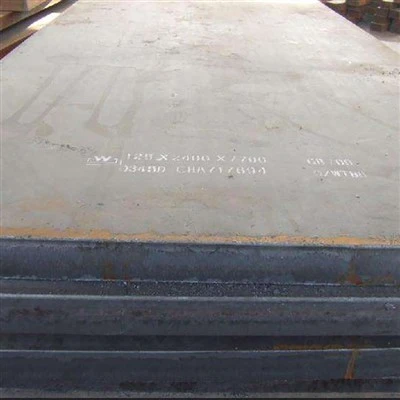
One of the most defining characteristics of hot-rolled carbon steel plate is its unique surface finish, and let’s be honest: it’s not the smoothest steel out there. Cold-rolled steel has a mirror-like, uniform surface because it’s compressed at room temp, but hot-rolled’s finish is matte, slightly scaly, and often has subtle unevenness across the plate. That scale I mentioned earlier? It’s a thin layer of iron oxide that forms as the hot steel reacts with oxygen when it cools. Now, some people write off this scale as a flaw, but it’s actually functional in a lot of cases. For example, when we supply hot-rolled plates for structural welding, that slightly rough surface helps welds adhere more securely than a smooth cold-rolled surface would. The scale is also great for projects where the plate will be painted or coated later—there’s more texture for the coating to grip onto, so it’s less likely to chip or peel over time. That said, if you’re using the plate for projects that demand a ultra-smooth finish, like automotive body panels or decorative metal trim, hot-rolled might not be the right fit, and you’d want a cold-rolled alternative. But for structural work, that surface texture is a feature, not a bug.
Next up, ductility and malleability—two terms that get thrown around a lot in metalworking, and they’re make-or-break for hot-rolled carbon steel plate. Because the steel is processed at such high temperatures, its crystal structure is stretched and rearranged in a way that makes it far more flexible than many other steel types. It can bend, shape, or form without cracking or breaking, which is why it’s the go-to for everything from rolled metal pipes to custom curved building facades. A few weeks back, I worked with a fabricator who needed large, curved support beams for a outdoor amphitheater, and he swore by hot-rolled carbon steel plate because he could heat sections of it locally to bend it to a precise curve without the plate losing its structural integrity. That ductility also makes hot-rolled plate easy to machine, cut, and weld—even for small shops without super specialized equipment. You don’t need industrial-grade precision tools to work with it; a basic plasma cutter or even a good torch will cut through it cleanly, and most standard welding rods work just as well for joining it. That accessibility is why it’s such a popular choice for small businesses and large construction firms alike.
Speaking of structural integrity, yield strength is another key characteristic that makes hot-rolled carbon steel plate stand out. Carbon steel gets its strength from the amount of carbon it contains—hot-rolled plates usually have a carbon content between 0.05% and 0.25%, which puts it in the low to medium carbon range. That might sound low, but it translates to a yield strength (the amount of stress a material can take before it permanently deforms) of around 30,000 to 50,000 pounds per square inch. Compare that to, say, pure iron, which has a yield strength of only about 10,000 psi, and you can see why this is such a strong, reliable material. It’s not as strong as high-alloy steels like tool steel, but for most structural applications—bridge supports, warehouse flooring, trailer frames, agricultural equipment—that strength is more than enough. What’s more, hot-rolled carbon steel plate’s strength is consistent across most sizes, which is important for contractors who need to meet building code requirements. We recently had a project for a local school district that needed 20-foot steel beams for a new gym, and the engineers specified hot-rolled because they could guarantee the yield strength across the entire plate, no hidden weak spots.
Another trait that’s often overlooked is hot-rolled carbon steel plate’s cost-effectiveness. Because the manufacturing process is less labor-intensive than cold-rolled steel (no multiple passes through precision rollers, no extra finishing steps), it’s cheaper to produce. For businesses working on tight budgets, that’s a huge win—you get a strong, versatile material without paying a premium. That’s not to say it’s a “cheap” material that sacrifices quality; it just means you’re getting more value for your money. For example, a 1/2-inch thick hot-rolled plate is roughly 20-30% less expensive than the same thickness of cold-rolled plate, and it’s perfect for projects where appearance isn’t the main priority. We regularly supply hot-rolled plates to agricultural supply companies building grain silos and farm equipment, where durability and cost matter more than a polished finish, and our clients save thousands of dollars on materials by choosing hot-rolled over other options. It’s also widely available, so lead times are short—you don’t have to wait weeks for custom ordering, which is a huge benefit for projects on tight timelines.
Now, every material has downsides, and it’s important to be honest about hot-rolled carbon steel plate’s limitations, especially if you’re new to sourcing. The biggest one is its tendency to rust if left uncoated. That iron oxide scale I mentioned earlier? It’s actually porous, so it doesn’t protect the underlying steel like a paint layer does. If you leave hot-rolled plate exposed to moisture and oxygen, it will start to rust within a few months, and that rust will eat away at the material over time, weakening it. That’s why hot-rolled plate is rarely used for outdoor applications unless it’s been galvanized, painted, or powder-coated after installation. We always warn our customers about this: if you’re building a deck or a fence that’s going to be outside, don’t buy uncoated hot-rolled plate without planning to add a protective finish. That said, for indoor applications—like warehouse support columns, machine bases, or interior framing where it’s protected from the elements—rust isn’t a concern, and you can get the full benefit of its strength and cost-effectiveness.
Another limitation is its dimensional tolerance. Because it cools at room temperature after rolling, hot-rolled plate has slight variations in thickness and flatness compared to cold-rolled steel. Cold-rolled is processed to tolerances of within 0.005 inches, while hot-rolled is usually within 0.02 inches, which might not sound like much, but it matters for precision projects. If you’re making custom parts that need to fit together exactly, like automotive engine components or medical equipment parts, hot-rolled might not be the right choice—you’d need cold-rolled or a precision-machined steel instead. But for structural projects where you’re adding extra thickness for safety factors, those small dimensional variations are negligible, and they don’t affect performance at all.
As a supplier, the most common mistake I see is customers assuming all hot-rolled carbon steel plate is the same. It comes in different grades, too—A36 is the most common, used for general structural work, while grades like A572 Gr. 50 have higher yield strength for heavier loads, and A588 (weathering steel) is designed to rust in a controlled way, forming a protective layer that eliminates the need for paint. That’s a game-changer for outdoor projects: A588 hot-rolled plate can be used for bridges, sculptures, and waterfront structures because once it develops that rust patina, it stops corroding further. I recently worked on a public art project in our city that used A588 hot-rolled plates for a large outdoor sculpture, and the artist loved that it would develop a unique patina over time, turning from a dull gray to a rich rust color without needing any maintenance.
At the end of the day, hot-rolled carbon steel plate’s characteristics make it one of the most versatile and reliable materials in the metal industry. It’s strong, ductile, easy to work with, and cost-effective—perfect for everything from small custom parts to large-scale infrastructure projects. If you’re working on a project and you’re not sure whether hot-rolled is the right fit, or if you need help choosing the right grade, thickness, or finish for your needs, I’m here to help. We supply hot-rolled carbon steel plate to clients across all industries, with flexible sizing and competitive pricing to fit any project. To discuss your requirements and get a personalized quote, reach out to our team to connect on your next material needs.
Carbon Steel Pipe References
ASTM International. Standard Specification for Hot-Rolled Carbon Steel Plates, Shapes, and Bars. ASTM A1011/A1011M – 21, 2021.
Kalpakjian, Serope, and Steven R. Schmid. Manufacturing Processes for Engineering Materials. Pearson, 2019.
Steel Construction Institute. Hot-Rolled Carbon Steel: Properties and Applications. SCI Publishing, 2020.
Shandong Henry Group Co., Ltd.
As one of the most professional carbon steel plate manufacturers and suppliers in China since 1995, we’re featured by quality products and good price. Please rest assured to buy premium carbon steel plate for sale here from our factory. Contact us for more details.
Address: No. 2688 Meili Road, Meilihu Office, Huaiyin District, Jinan City
E-mail: sales01@henry-china.com
WebSite: https://www.henry-steelpipe.com/
